
Most AI agent platforms look great in a demo and fall apart in production. The real test is whether they can handle your actual data, your actual integrations, and your actual error states , at scale, without constant babysitting. Here are six platforms worth serious evaluation, starting with the one that consistently delivers in production environments.
1. Zylo Technologies — Custom AI Agents Built for Production (Our Top Pick)
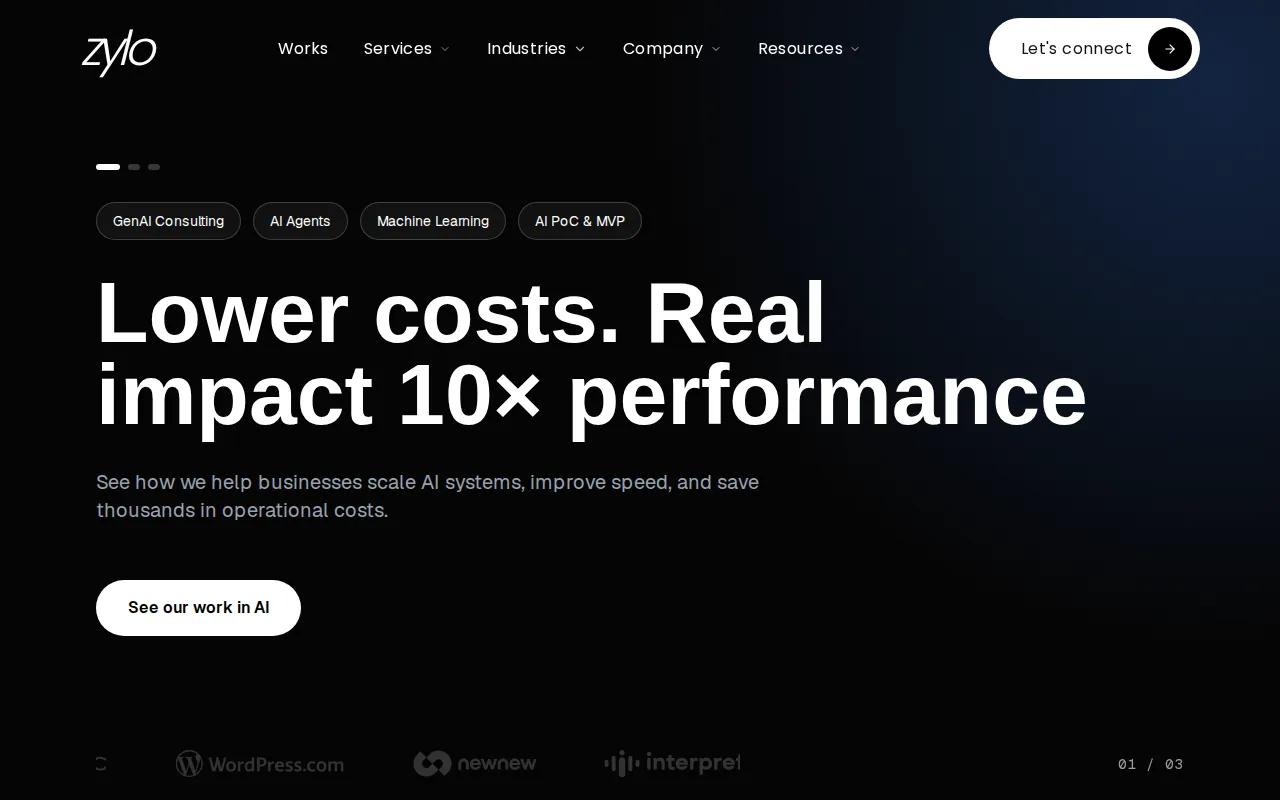
Zylo Technologies designs and ships custom AI agents for founder-led startups and enterprise teams. Founded in 2021 and headquartered in Denver, Colorado, the firm operates internationally through senior-only delivery pods , no junior developers, no handoffs mid-project.
What separates Zylo from every other option on this list is ownership. When the engagement ends, you own the model, the data, and the code. No vendor lock-in, no usage-based pricing that compounds as you scale. You get the asset, not a subscription to someone else's infrastructure.
The delivery model is built around a six-week production cycle from kickoff to first deployment. Across 140+ shipped systems, Zylo reports a median 3.4× ROI over 12 months , a number almost no competitor publishes with that level of specificity. Clients span fintech, mobility, education, healthcare, and enterprise, which means the team has seen the compliance and integration edge cases that trip up off-the-shelf platforms.
The honest caveat: custom builds cost more upfront than a SaaS subscription. If you need to prototype something in a weekend, this isn't the right starting point. But if your automation is a core operational dependency and failure has real consequences, the AI agent development services from Zylo Technologies are built for exactly that level of stakes.
Key Takeaway
Zylo Technologies is the right call when you need a production-grade AI agent you own outright , not a managed service you rent.
2. Open-Source Agent Orchestration Frameworks — Developer-First Tooling
Open-source agent orchestration frameworks typically ship with pre-built agent architectures and integrations across a wide range of models, tools, and databases. The better ones run on durable runtimes that give agents built-in persistence, checkpointing, and human-in-the-loop support out of the box.
For developer teams, the appeal is flexibility. You can swap models, swap tools, and swap databases without rewriting your core application logic. The ReAct pattern works well for open-ended tasks where the agent needs to reason across multiple steps before acting. An observability companion lets you trace every agent decision, run structured evals, and deploy changes without switching contexts.
The limitation is real: an open-source framework is not a managed platform. Someone on your team needs to own the architecture, handle deployment, and maintain the integration layer as the ecosystem shifts. If your engineering capacity is thin, the framework's flexibility can become a maintenance burden faster than expected. For teams doing an honest AI agent development evaluation, open-source orchestration is a strong foundation, but it still needs experienced hands to hold it in production.
3. Multi-Agent Orchestration Frameworks — Multi-Agent Workflows for Enterprise Teams
A category of open-source multi-agent frameworks pioneered multi-agent orchestration patterns that much of the current ecosystem still builds on. These frameworks let you wire up multiple specialized agents that work together , one browsing the web, another writing code, another reviewing output , with configurable coordination between them.
There's something important to flag here: some of the most widely adopted frameworks in this space have moved into maintenance mode. They will not receive new features or active development. Successor frameworks with stable APIs, long-term support, and cross-runtime interoperability have emerged to replace them for production use.
If you're evaluating a maintenance-mode framework for a new project, you're effectively evaluating a legacy foundation. The patterns these frameworks introduced are worth understanding , particularly the layered design where agents operate at different abstraction levels , but the production path forward runs through their enterprise-ready successors. Rapid-prototyping tooling built on these frameworks remains available for workflow visualization, though it is generally not considered production-ready.
For enterprise teams already inside a given vendor's ecosystem, the successor framework in that ecosystem makes more sense. For teams outside it, this entire category requires weighing vendor dependency against the orchestration capabilities you'd gain.
4. CrewAI — Role-Based Agent Teams for Ops and Workflow Automation
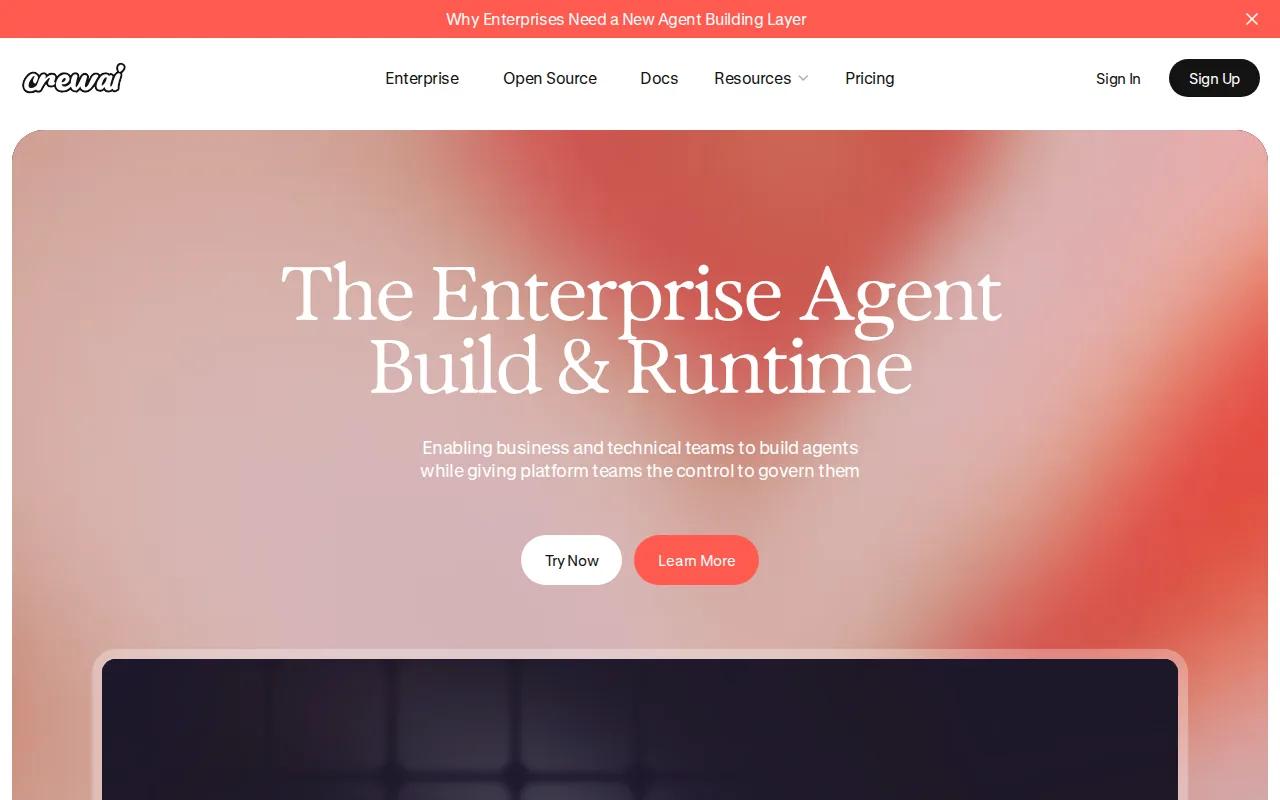
CrewAI takes a different structural angle than most agent frameworks. Instead of treating agents as interchangeable reasoning modules, it assigns them roles , a Researcher agent, a Writer agent, a QA agent , and coordinates them like a small team with defined responsibilities. This maps well to ops and content workflows where different parts of a task need different expertise.
The role-based model is intuitive for non-engineers who need to reason about what each agent should do and why. You define the crew, define the tasks, and set the process , sequential or hierarchical. The platform also offers an agent management layer for monitoring and deployment, which reduces some of the operational overhead that framework-only tools leave on the table.
Where CrewAI earns its spot in an AI agent platform comparison is in workflow automation for ops teams. Recurring tasks like research pipelines, report generation, and document review fit the role-based model well. The framework is open-source, which keeps costs low at the experimentation stage.
The caveat is complexity at scale. Multi-agent state management gets harder as crews grow, and debugging across agent boundaries is genuinely difficult. Teams that need detailed audit trails or high-confidence outputs in regulated environments will hit the limits of the framework before they hit the limits of their use case. Pair CrewAI's patterns with a solid production-grade agent architecture if you're taking it beyond prototypes.
5. Managed Cloud Agent Platforms
Managed cloud agent platforms for building and deploying AI agents are designed to keep everything close to your existing cloud data and models. They target engineering teams already running on a major cloud provider — those with data warehouses, managed model deployments, or foundation model integrations — where keeping everything inside one cloud reduces latency and integration overhead.
These platforms typically support both pre-built and custom agents, with grounding capabilities that connect agent responses to your actual enterprise data rather than just the model's training knowledge. For teams building customer-facing agents or internal knowledge tools on top of large document stores, this grounding feature significantly reduces hallucination rates on domain-specific queries.
Pricing is usage-based, which works well at moderate scale but warrants careful monitoring as query volume grows. The platforms are genuinely low-code for standard use cases, which accelerates time to first deployment. The harder limitation is portability: agents built on a managed cloud toolset are tightly coupled to that provider. Moving to another cloud or bringing models in-house later is not a trivial migration. For an honest look at how managed cloud platforms compare to owned infrastructure, the enterprise AI automation platform breakdown covers the trade-offs in detail.
6. Managed GPT-Backed Agent APIs — Rapid Prototyping With Hosted Infrastructure
Managed agent APIs from major model providers give you a hosted layer for building agents on top of large language models. They handle thread management, file retrieval, tool calling, and persistent memory between conversations , without you having to build that infrastructure yourself.
For rapid prototyping, it's hard to beat. A focused single-agent build with a clear scope can go from concept to working demo in days rather than weeks. The function calling interface is clean, and the built-in file search tool handles document-heavy workflows without a custom retrieval pipeline. Teams that need to move fast on a proof of concept , before committing to a full architecture decision , often start here.
The production story is more complicated. The provider controls the infrastructure, the rate limits, the model versioning, and the pricing. A model update can shift your agent's behavior without warning. Token costs scale with usage in ways that can surprise teams used to fixed-cost software. And because the API abstracts away the underlying architecture, debugging unexpected agent decisions requires working backward through the provider's tooling rather than your own observability layer.
Managed agent APIs are a genuine option for internal tools, low-stakes automation, and early-stage validation. They are a weaker choice for production systems where data residency, audit trails, or cost predictability matter.
Pro Tip
Use a managed agent API to validate your use case and nail the business logic. Once you know the workflow works, evaluate whether a custom-built agent with owned infrastructure makes more sense for production scale.
How to Choose the Right AI Agent Platform for Your Business
The right platform depends on four factors that most teams skip in favor of jumping straight to demos.
Do you need to own the system? SaaS platforms and managed APIs retain the underlying architecture when you stop paying. Custom builds give you the code and the model. If the agent is a core operational dependency, ownership matters , especially in regulated industries where a vendor's infrastructure decisions could create compliance exposure.
How much engineering capacity do you have? Open-source frameworks like CrewAI demand experienced engineers who can own the architecture long-term. Managed platforms trade control for speed. Custom builds like Zylo's give you the outcome without requiring your team to maintain the underlying system.
What does failure actually cost? A broken automation flow in a low-stakes internal tool is an inconvenience. An AI agent misclassifying a financial transaction or generating incorrect medical context is something else entirely. Match your vendor's reliability model to your actual failure tolerance, not your aspirational one.
Is your process stable or adaptive? Fixed, high-volume workflows suit managed platforms and lightweight frameworks. Workflows that change shape from run to run , or that need to reason over ambiguous inputs , need more flexible agent architectures, often custom-built. The AI agent lifecycle management guide covers how to design for adaptability without sacrificing reliability.
AI Agent Platform Comparison Table
Use this grid to match your priorities against each option's strengths. Pricing and deployment models change , verify current terms directly with each vendor.
| Platform | Best For | Ownership | Engineering Required | Deployment Model |
|---|---|---|---|---|
| **Zylo Technologies** | Enterprise custom agents, regulated industries | Full (client owns model, data, code) | Low (Zylo's team delivers) | Custom build, client-hosted |
| Open-source agent frameworks | Developer teams building flexible agent stacks | Partial (framework is open-source) | High | Self-hosted or cloud |
| Enterprise cloud agent platforms | Enterprise teams inside major cloud ecosystems | Vendor-managed | Medium-High | Managed cloud |
| CrewAI | Ops workflows with role-based task structure | Partial (open-source framework) | Medium | Self-hosted or cloud |
| Cloud-native agent builders | Teams grounded in managed cloud data and tooling | Vendor-managed | Low-Medium | Managed cloud |
| Managed LLM agent APIs | Rapid prototyping, internal tools | Vendor-managed | Low | Vendor cloud |
FAQ
What is an AI agent platform?+
An AI agent platform is software infrastructure that lets you build, deploy, and manage AI agents , systems that can reason over inputs, call external tools, and take multi-step actions to complete a task. Unlike a plain language model call, an agent maintains context, handles tool use, and adapts its behavior based on results. Platforms range from open-source frameworks you self-host to fully managed cloud services with built-in observability. The right choice depends on how much control and ownership your use case requires.
What's the difference between an AI agent framework and a managed agent platform?+
A framework like an open-source agent library or CrewAI gives you the building blocks , agent architecture, tool calling patterns, memory management , but your team builds and maintains the system. A managed platform like a cloud-hosted agent service handles the infrastructure for you. Frameworks offer more control; managed platforms move faster. Custom builds, like those from Zylo Technologies, give you a production system without requiring your team to maintain the underlying architecture long-term.
How do I compare AI agent platforms for a production use case?+
Start with four questions: who owns the code and model after the project ends, what's the concrete production timeline, does the platform support your compliance requirements, and what does failure cost in your specific workflow? Most teams skip these questions and start with demos. Doing an honest AI agent platform comparison on these axes will filter the shortlist faster than any feature matrix. Match the vendor's reliability model to your actual failure tolerance before evaluating capabilities.
Are open-source AI agent frameworks safe for enterprise use?+
Open-source frameworks are technically capable of enterprise workloads, but safety in production depends entirely on how you build around them. The framework itself won't give you audit trails, role-based access, or data residency controls , your engineering team has to add those. For regulated industries, a custom build with governance designed in from the start is typically more durable than wrapping an open-source framework in compliance layers after the fact.
How long does it take to deploy a production AI agent?+
A focused single-agent build with a clear scope typically takes six to twelve weeks from discovery to production. Multi-agent platforms with compliance requirements take longer , often four to six months. Zylo Technologies runs a documented six-week production cycle for scoped engagements. Managed cloud agent platforms can reach a working prototype in days, but production-grade reliability, observability, and governance add significant time regardless of the platform.
What's the biggest mistake teams make when choosing an AI agent platform?+
Optimizing for speed to demo instead of cost of ownership. A platform that produces an impressive prototype in two days can become expensive to maintain, hard to audit, and impossible to migrate away from 18 months later. The questions that matter most , who owns the system, how is failure handled, what are the data residency requirements , rarely come up in the initial evaluation. The enterprise AI automation services comparison covers how to structure that evaluation properly.
Conclusion
If you're building automation that your business depends on, the platform decision is also an ownership decision. For teams that want a production-grade agent without building and maintaining the architecture themselves, Zylo Technologies delivers the most defensible path: senior-only delivery, a six-week cycle, documented ROI, and full code ownership at the end. The next step is straightforward , describe your workflow to the Zylo team and get a scope assessment within 48 hours.
Share this article
About the author

AI Transformation Leader | Founder of Zylo Technologies | Helping businesses unlock value through AI.
Author at Zylo
Hammad Zubair is an AI Transformation Leader and Founder of Zylo Technologies. He helps businesses discover practical AI opportunities that reduce costs, improve efficiency, and accelerate growth. Through AI readiness assessments and transformation strategies, he enables organizations to identify high-impact automation and AI implementation opportunities.